
From Mithras to Hildegard
Archaeology, art, and some soulful encounters

Hey Epic Human,
What does a Roman mystery cult, a medieval mystic, and a stained-glass dome have in common?
Where I last left off, we were departing our house-sit with darling Merle in Modautal, Germany, our hearts breaking as the sun set.
But we did not leave Germany—at least, not for the moment. No, we decided to build in a sightseeing buffer to take in many of the sights we didn’t have time for during the sit. Accordingly, we crammed in a LOT in a short amount of time. (My head is still spinning!)
Let me share some of the highlights (with more to come).
First, we took a quick detour to visit the grave of the Red Baron in Wiesbaden. Yes! The Red Baron was a real person. Manfred Albrecht Freiherr von Richthofen, known in English as Baron von Richthofen (or “the Red Baron”), was a fighter pilot with the German Air Force during World War I. He was shot down and killed over France on April 21, 1918—not by Snoopy—but by Roy Brown from Canada.


The Red Baron is considered the ace-of-aces of the war, officially credited with 80 air combat victories, and remains one of the most widely known fighter pilots of all time.
From there, we made our way to the Wiesbaden Museum, with its astonishing trove of art nouveau and old masters.
The museum owes much to Johann Wolfgang von Goethe, who, smitten with Wiesbaden’s charm (and spas), persuaded his Frankfurt friends Johann Isaak and Johann Christian Gerning to donate their impressive collections to the city in 1825: in exchange for a life annuity, the Gernings gifted a treasure trove of 156 artworks and countless cultural gems. It was a win for everyone—and a major leap forward in shaping the cultural heart of Wiesbaden.
Here I am with the statue of Goethe on the front steps! (He’s been a running thread throughout our travels in Germany.)
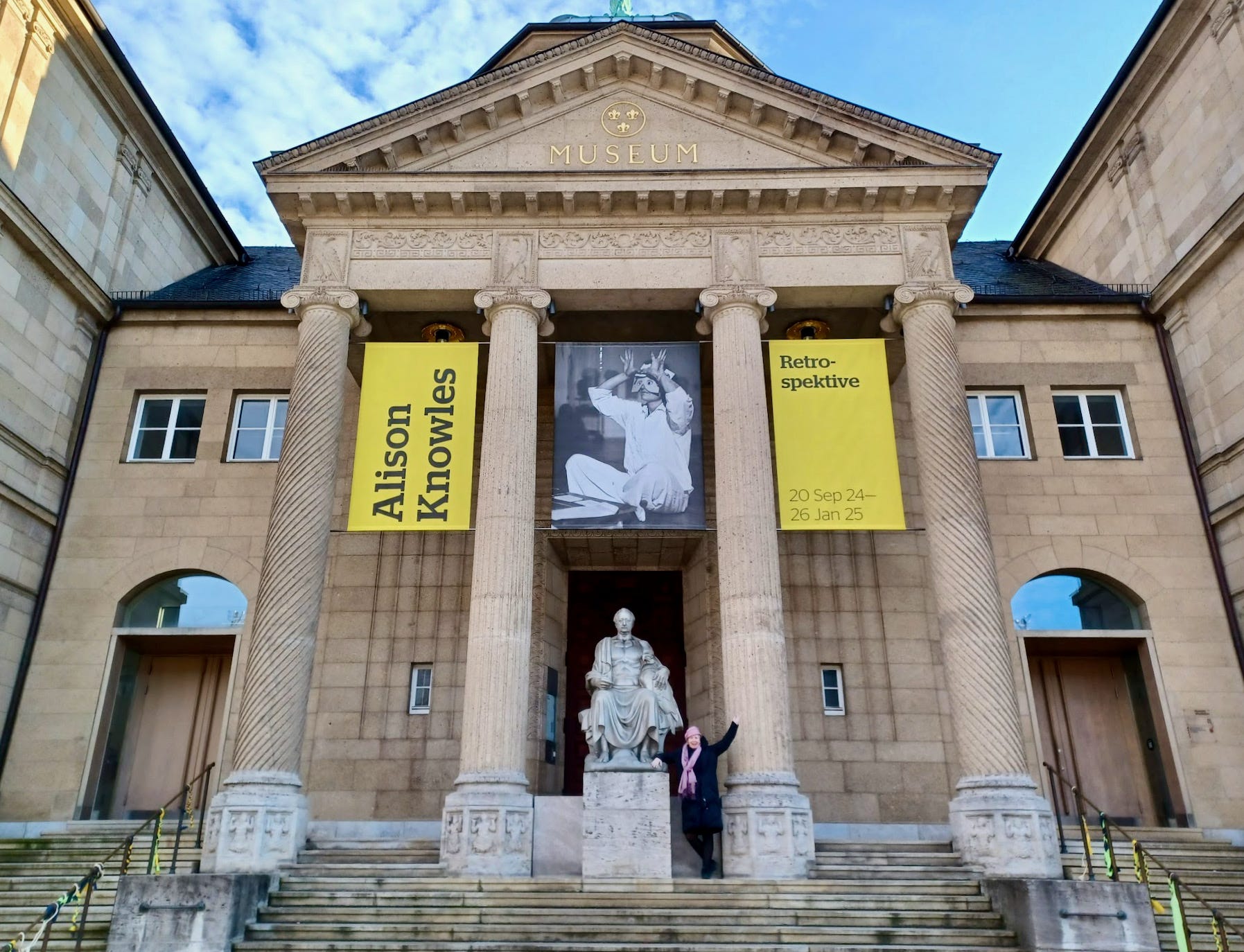
Goethe’s contribution to the history of the museum is set in proverbial stone in the foyer of the building, which features this granite sculpture in his likeness. Goethe has presided there since 1919, idealized as a bare-chested Jupiter, father of the gods.
As soon as I entered, I was captivated by this mosaic glass dome twinkling at me (shades of Ravenna!). It was made in 1926 by Adolf Hölzel, but was only acquired in 2020.
In the late 19th century, Adolf Hölzel, along with Wassily Kandinsky (one of the most important pioneers of abstract art), produced four stained glass windows for primarily industrial clients. Upon closer inspection, we can make out a number of small figures who appear to be reading. Rows of figures lead our gaze upwards, where houses and churches, meadows, fields, trees, and clouds complete the stained-glass microcosm.


The message appears to be that reading and research take us to a higher place, up to the mountain in which the window culminates. Then, behind this scientific, spiritual world, is a radiant sun—which not only brings the entire universe to life, but sustains it. Without it, there is no reading and no knowledge; without it, the glass picture remains dark and incomprehensible. Only when it shines, Hölzel tells us, can we see a “brilliance as from gemstones.”
Here is 1:23-video panning around that gorgeous mosaic ceiling.
The site for which this work was originally created—a library—reinforces the secular interpretation that Hölzel posited — that intellectual reading was an avenue to explore the interrelationships of the world. Boy, he’s got my number!
The south wing of Museum Wiesbaden is home to a Jugendstil collection of 570 works that is now one of the most important private collections of Art Nouveau and Symbolism in Europe. It was gathered over the course of more than 40 years by Ferdinand Wolfgang Neess, who gifted it to the museum in 2017.
The exhibition was opened remarkably recently—on June 29, 2019—and we felt privileged to see it.


Art Nouveau emerged as a revolutionary style in the 1890s and flourished until the First World War. Originating in Great Britain with the Arts and Crafts Movement, known in France and Belgium as Art Nouveau, in Germany as Jugendstil, in Vienna as Secessionsstil, and in Spain as Modernismo, it should be understood as a pan-European movement.
Here are a couple of galleries with some works that caught my eye—whether it’s Medusa, alongside a painting of Melusina meeting the knight, and Parsifal in the lower right of the first gallery—the imaginative features of these works is boldly evident.


A good number of pre-Raphaelite works in the collection naturally caught my eye. Unfortunately, the lighting often reflected off the works, and sometimes I took the picture at a steep angle to avoid those awful lighting artifacts, sigh.


A section of the museum was dedicated to the imagery of Loie Fuller, who I think is represented by the golden center statue in the gallery above. Loie seems like a joke to us today, but at the height of her fame, she was considered radical and marvelous. This 1:18-minute colorized clip provides a taste of Loie Fuller and the phenomenon she was.
This was a curious museum in that it also featured a natural history section—which used to be a separate museum altogether, but was combined with this one. It’s weird to stroll from art nouveau masterpieces into material reality this way.
Having said that, it was fun to meet the “Terror Beast of Eppelsheim,” as they called it.
The original skull (a cast of which is seen here) was found in 1835 in Eppelsheim, trapped in 9-million-year-old sediments of the ancient Rhine. A great source of mystery were the large tusks which curved downwards and backwards, the use of which is still not fully understood.
Given the lack of any other skeletal remains, the skull was initially attributed to a giant tapir. The tilted position gave rise to speculation that it might belong to a giant sea cow or a walrus.


Robin is standing between the tusks of a walrus skull. The walrus (Odobenus rosmarus) is characterized by its prominent tusks, which can grow to more than three feet in length.
On a later date, we returned to Frankfurt and took in a museum that I’d been angling to visit for months!
I must say, every once in a while, we go to a museum that makes me want to pitch a tent and move in for a while, just to soak it all up and drink it in. The Archäologisches Museum Frankfurt was one such museum.
Guess what the big attraction was!

I’m on a big ole Mithras kick! (I’ve written about Mithras before.) Given that Mithras was a “mystery cult” favored by Roman soldiers, little is known about it (rather like the Eleusinian Mysteries, which were practiced by Roman women). Few things have been written about either, so historians and archeologists have pieced together speculations from the evidence they have gathered.
Below is the front and back of a ginormous rotating panel—the front (left) shows the “tauroctony”—the depiction of the god Mithras slaying the bull. There’s no written historical text that gives a definitive explanation about the significance of the scene, since Mithraism was only ever an oral tradition.
Historians and archaeologists have argued for decades about the true meaning of the tauroctony, generally linked to Zoroastrian myths, as well as having astrological significance. The slaying of the bull was believed to be a mythic act of cosmic regeneration and may have represented the initiate’s own journey—from earthly, material existence (the bull) to spiritual enlightenment or rebirth through sacrifice and discipline. We may never know!


On the back of this rotating panel is an image of the Mithraic priests carving the slain beast (right), preparing a banquet to share with the god Sol Invictus (the sun). This panel had been placed in front of the reconstruction of a Mithras temple, a “Mithraeum.”
Professor Hutton provides a 5:50-minute explanation of the cult of Mithras below.
For C. G. Jung, the image of Mithras slaying the bull was a symbolic expression of an inner psychological drama. Rather than reading the myth as literal, Jung interpreted it mythopoetically, meaning that the slaying of the bull (a sacred animal) represented the sacrifice of instinct—or the taming of primal energies—in the service of spiritual development.
The bull, in Jung’s reading, symbolized raw instinctual energy, including sexuality, aggression, and vitality. These are necessary and powerful, but must be transformed or “sacrificed” to enable psychological growth.
Mithras, as the solar hero, was the emerging ego or Self that takes on the great task of ordering the unconscious and initiating a new level of consciousness. This mirrors the individuation process, in which we must face, integrate, and transform our unconscious drives rather than suppress or be ruled by them. Jung often identified solar figures (like Mithras, Christ, Horus, etc.) with the archetype of the Self—the organizing center of the psyche that transcends the ego.
Mithras slaying the bull isn’t about cruelty, but about bringing light out of darkness, order out of chaos, consciousness out of instinct. This act is not destructive but generative—just like individuation requires facing the shadow and suffering a symbolic “death” before rebirth. In this sense, Mithras is not unlike Christ in Jung’s psychological theology—both represent a mediating figure who reconciles opposites: light and dark, life and death, human and divine. Below is a 1:04-minute video showing off the artifacts.
At the temple’s entrance we meet Aion as a guardian figure. (Aion is the personification of time: think “eon.”) In this case, the temple is a makeshift one built of black cloths—similar to a black box theater. The Mithraeum where these artifacts were found was abandoned and destroyed towards the end of the 4th century A.D.
The next image shows the path initiates would take when approaching the altar, and Mithras dominating the scene at the end, flanked by his companions, Cautes and Cautopates.


This path was a marvelous find because its mosaics likely symbolize the seven levels one could attain in the cult. The seven levels represented include: Corax (raven), Nymphus (bridegroom), Miles (soldier), Leo (lion), Perses (Persian), Heliodromus (sun-runner), and Pater (father). This 2:07-minute video slowly walks up the path to the tauroctony, showing the symbols clearly.
The Archäologisches Museum Frankfurt is an immersion into the deep past of both the city and the region, set within the atmospheric walls of a 13th-century Carmelite monastery. Officially founded in 1937, the museum sits on sacred ground: the monastery church itself is the largest surviving Gothic cloister in Frankfurt. Once home to a thriving religious community, the site was secularized in the early 19th century and repurposed over time.
The artifacts were wonderful! I enjoyed my encounters with Hermes and Demetrios, but it was a tiny silver scroll that really grabbed my attention!
A small silver amulet, a bit more than one inch long, contains a mysterious engraving rolled inside known as the “Frankfurt Silver Inscription.” Experts agree that the 18 lines inscribed on it enormously enrich existing research on the spread of Christianity and the late period of Roman rule along the Rhine.
The inscription was deciphered thanks to state-of-the-art computer tomography technology, which shows that the text can be interpreted entirely in Christian terms—something absolutely extraordinary for this period.
The grave in which the amulet was found is dated to between 230 and 260 A.D. Such early, authentic evidence of pure Christianity north of the Alps has never existed before — all other finds are at least 50 years younger.


Although there are historical references to the first Christian groups in Gaul and perhaps also in the province of Upper Germania in the late 2nd century, reliable evidence of Christian life in the northern Alpine regions of the Roman Empire generally dates back to the 4th century A.D.
The “Frankfurt Silver Inscription” is therefore one of the most important testimonies to early Christianity worldwide. Its discovery opens up new horizons for archaeology, historical sciences, and theology. Here is a 7:55 clip about the scroll:
The cloister and refectory interiors are adorned with significant Renaissance wall paintings created between 1514 and 1521 by Jörg Ratgeb that depict biblical stories and the history of the Carmelite Order. These frescoes are considered among the most important north of the Alps and are notable for their scale and narrative depth.
Ratgeb depicted approximately 40 scenes from the Christian salvation history, ranging from the Creation to the Last Judgment.


However, the fresco shown on the right above is not by Ratgeb—it is by Johann Balthasar Bauer, said to be 19th-century copy (or interpretive reproduction) of Ratgeb’s original fresco. Here is a quick 2:52-minute pan around the amazing frescoes in the cloisters.
Although only a portion of the original work survives today, these frescoes offer a vivid glimpse into Ratgeb’s expressive style, and likwise provide a compelling window into the religious and artistic milieu of early 16th-century Germany.
As you can see, Jack Frost was still quite evident on the landscape! Robin found us a cute little airBnB to stay in with all the amenities, including a heated floor. I was fascinated by this tabletop dishwasher—it’s not something we’ve encountered before.


One of the reasons we decided to extend our stay in this part of Germany was because we hoped to spend more time visiting the various Hildegard von Bingen sites. We had toured a museum a few years ago, but many more sites were beckoning. We managed to take in about five sites over two days, which was quite an achievement!
Robin arranged for a guide to show us around a few special places. Villa Rupertsberg is the site where Hildegard founded her first monastery in the 12th century.
This stained glass window at the entrance to the Villa Rupertsberg cellar depicts the saint with flames on her head, representing the visions she received that were said to originate from God.
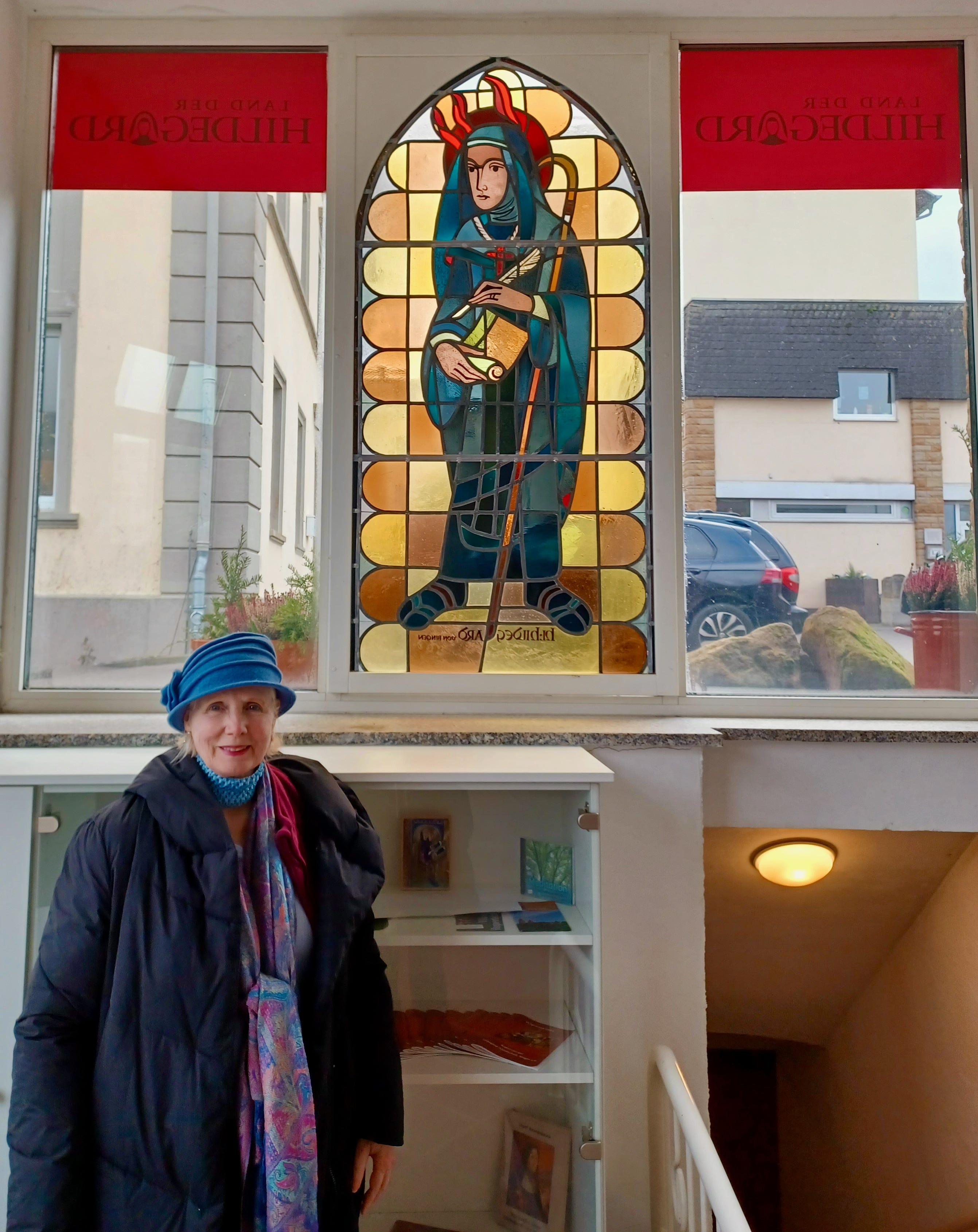
Hildegard von Bingen was a 12th century German Benedictine abbess and polymath who was active as a writer, composer, philosopher, mystic, and visionary, as well as a medical writer and practitioner. In 2012 she was the first woman in Central Europe to be elevated to the rank of Doctor of the Church by Pope Benedict XVI.
After centuries of disuse, the cellar of the original monastery has been excavated and converted into a meeting room and museum. As you can see, it’s constructed of rough stone and mortar.

The few remains of the monastery ruins were integrated into a new building, including six pillars of the southern nave wall of the monastery church, which were restored in 1976.
We enjoyed a private showing around this cellar that now houses a tiny museum dedicated to Hildegard. We could feel the presence of the individuals who once walked these floors in this space.
The arches seen below are from the original monastery and have been refinished with modern materials to preserve them.


We were treated to the “elevator to the past,” which provides a time-traveling experience to explore the world of Hildegard. This interactive exhibit used multimedia technology to digitally reconstruct the Rupertsberg monastery as it might have looked in the 12th or 13th century.
We were given a virtual tour of the church, cloister, courtyard, and church tower, experiencing the sounds and sights of Hildegard’s time. Here is the entire 4:24-minute video experience!
Our guided tour ended within the walls of the church of St. Rupertus and St. Hildegard, a neo-Romanesque style church consecrated in 1892 that seeks to recall the form of Hildegard’s original monastery church.


The front and back of the church are shown above, and two statues of Hildegard are visible. I especially liked the relief carving above the door of the sanctuary.
The church impresses with its simplicity and, above all, with the life of Hildegard, which is depicted in five stained-glass windows in the transept.


Here was the site’s piece de resistance! This shrine inside a small, locked side chapel contains the combined relics of Saint Hildegard and of Saint Rupertus the Confessor, the patron saint of pilgrims, who lived and worked here in the 8th century.


On another day, we drove out to visit Eibingen Abbey. Founded by Hildegard in 1165, this abbey is home to a community of Benedictine nuns who work in the vineyard and in the craft workshops, besides undertaking the traditional duties of hospitality. They conform to the same Benedictine rituals established by Hildegard over 800 years ago.
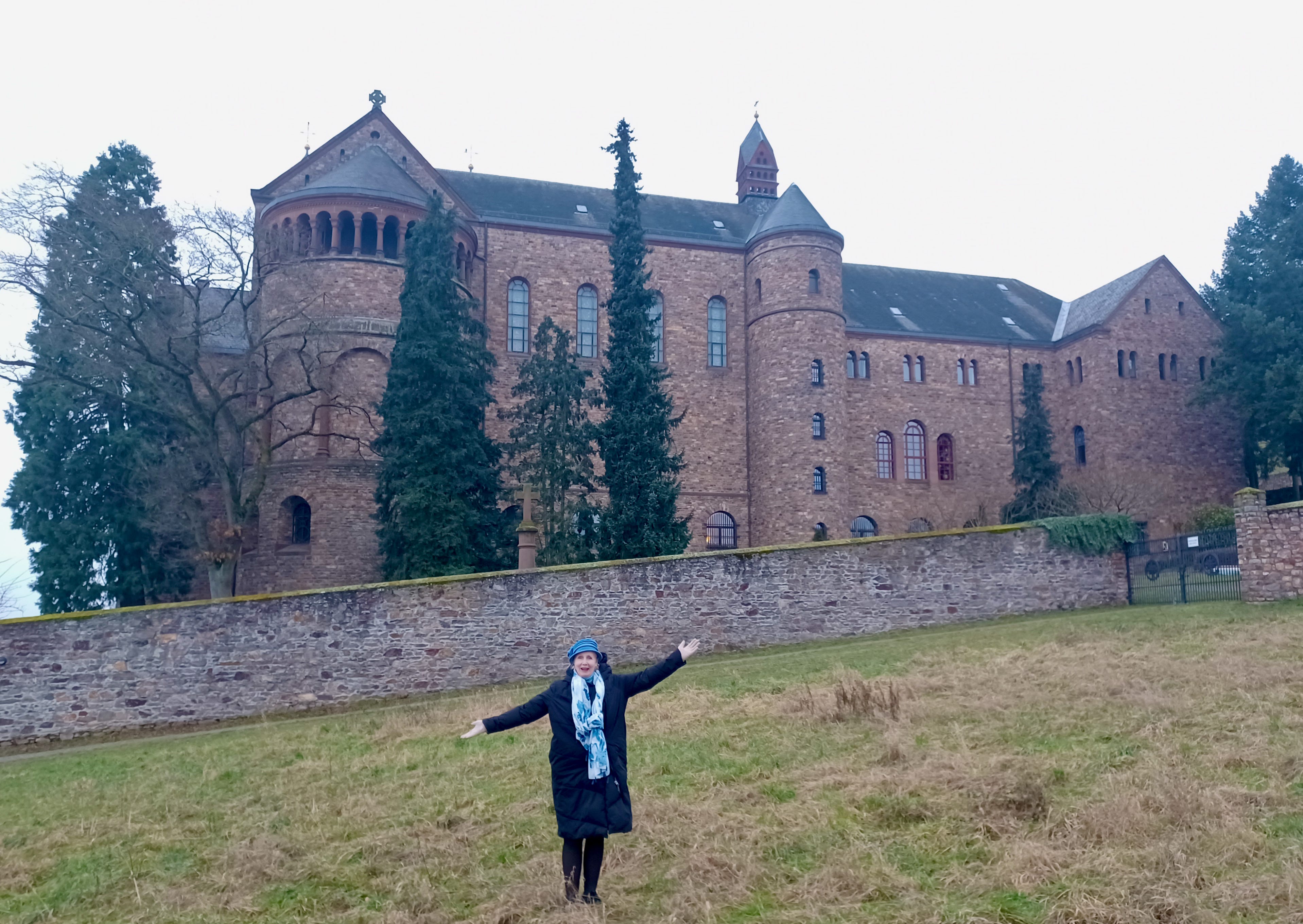
The original buildings from the 12th century have long since disappeared due to neglect, and this modern complex was built between 1900 and 1904, with the monastic church consecrated on September 7, 1908. Today, 47 Sisters aged between thirty-four and ninety-four live within the abbey.
Another Hildegard sculpture was awaiting us as a watchful guardian. This bronze statue was presented to the abbey in 1998.

The abbey features another church built in the neo-Romanesque style.
“Let the oratory be what it is called, a place of prayer; and let nothing else be done there.” —Rule of St Benedict, Ch 52, 1.
The abbey church of St Hildegard was erected between 1900 and 1904. It is used regularly for concerts, primarily featuring the music of Hildegard.

The interior of the church is dominated by the monumental figure of Christ in the apse. He appears as “pantokrator,” the king and sublime ruler of the universe, but at the same time He is man’s brother, who welcomes and receives everyone with outstretched arms.
Christ is not only the center of the abbey church, but also of the Benedictine lifestyle.
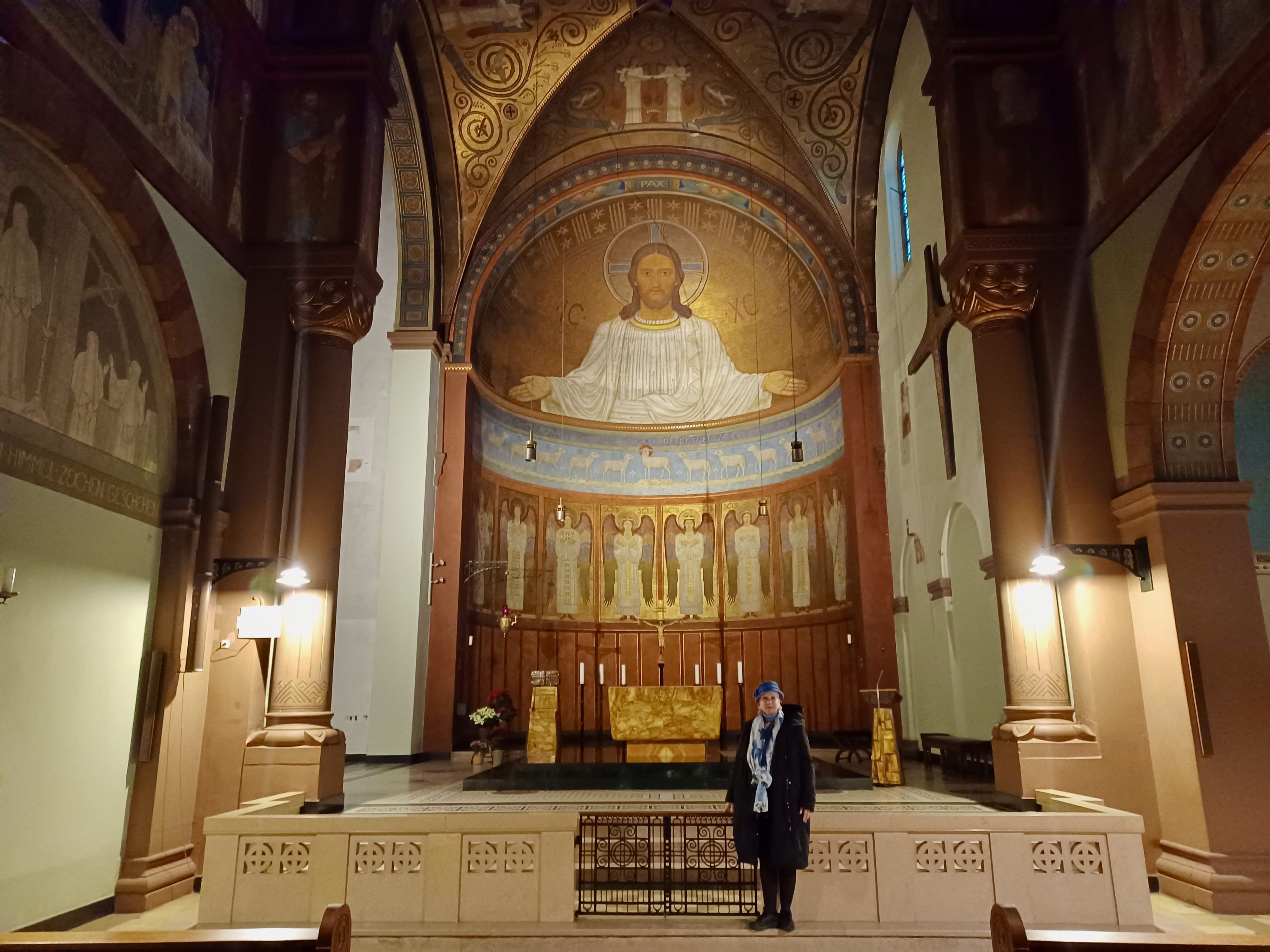
The church features a fresco depicting Hildegard as a prophet.
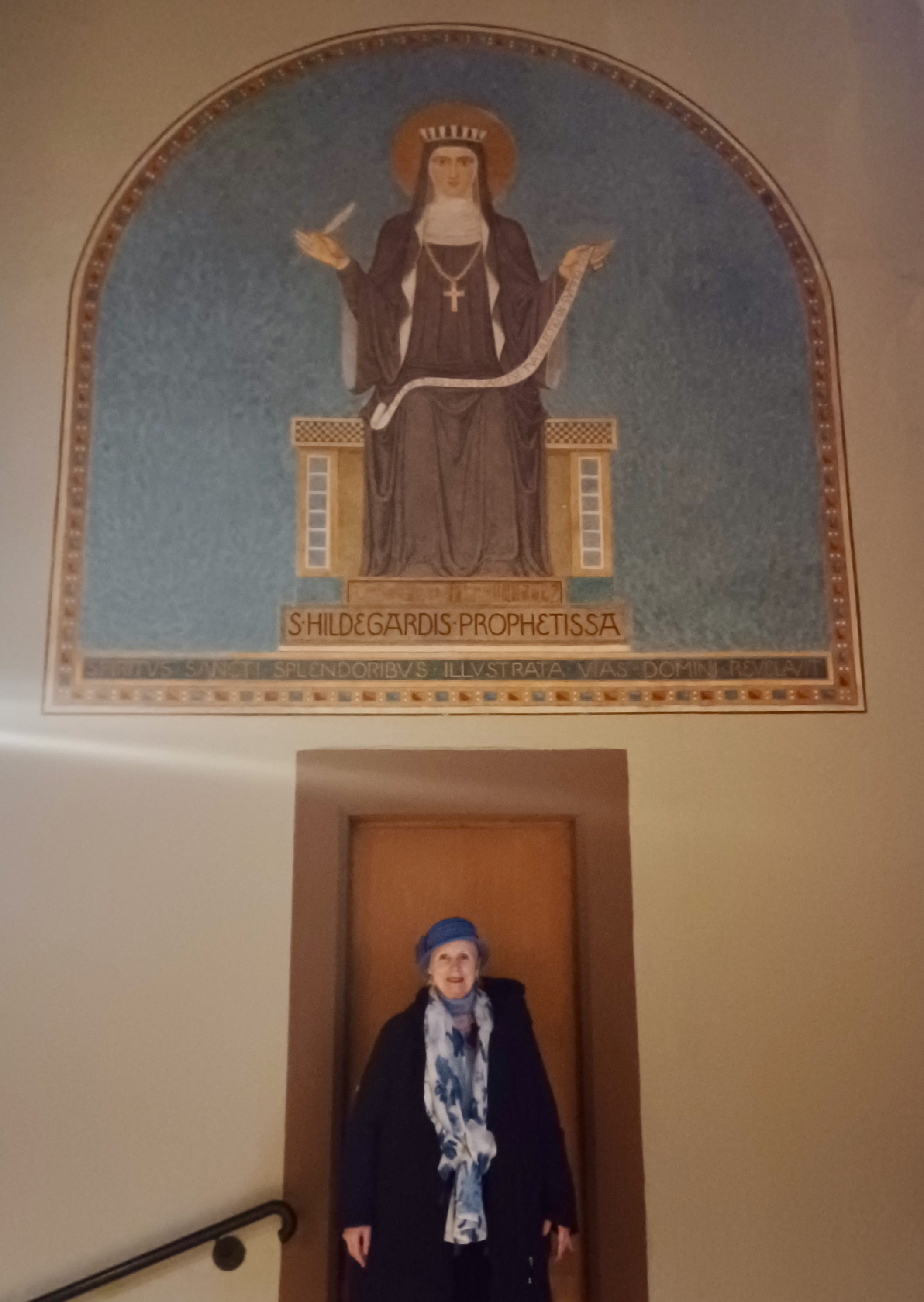
It was disappointingly dark inside, and we were unable to turn on additional lights, so I can’t really share all the beautiful artwork we saw within. Nevertheless, here’s a tiny taste of the marvelous beauty found there.
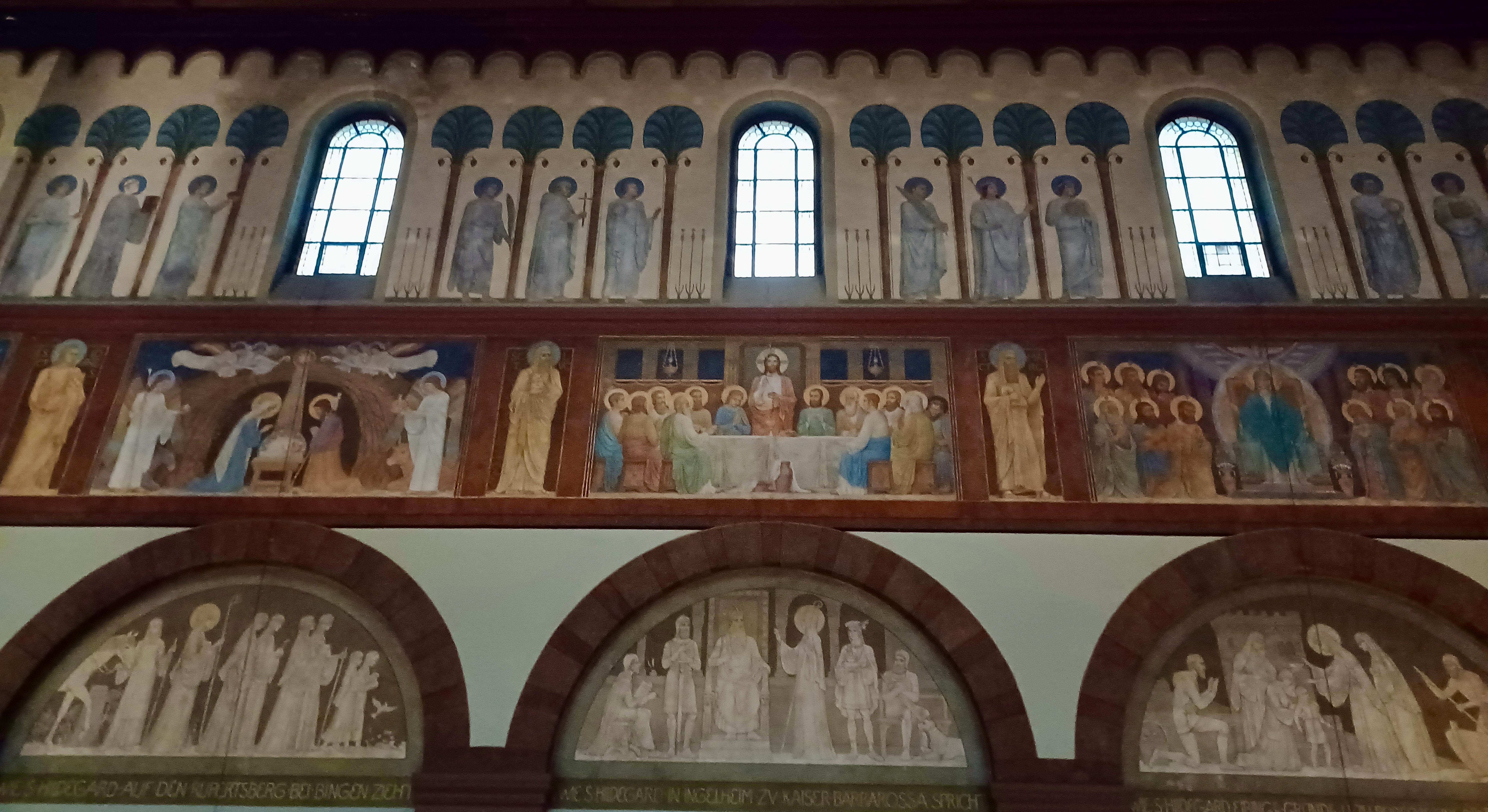
These interior paintings were added between 1907 and 1913 and are examples of the Beuron School of Art. This School was born in the late 19th century when Father Desiderius Peter Lenz became interested in ancient Egyptian art as a means of turning to a genuinely Christian form of art to express eternal religious truths. The ambitious and sophisticated aim of the Beuron School was to reform Christian art by returning to the roots of divine Christian nature and create a living space for the renewal of monasticism and liturgy.
Beuronese art is nearly unique in the clarity with which it reveals the “resting in God,” an essential feature of mystical contemplation.
The abbey also features a winery!
“Wine – when enjoyed in moderation – heals and delights humankind through its great strength and warmth.” —St Hildegard of Bingen
Hildegard established this winery in the 12th century and taught the Sisters to successfully grow wine. Today, the nuns in the abbey continue this tradition with modern, eco-friendly vinification techniques. Throughout the whole of Germany, it is the only monastic vineyard which is completely managed by the members of an order.
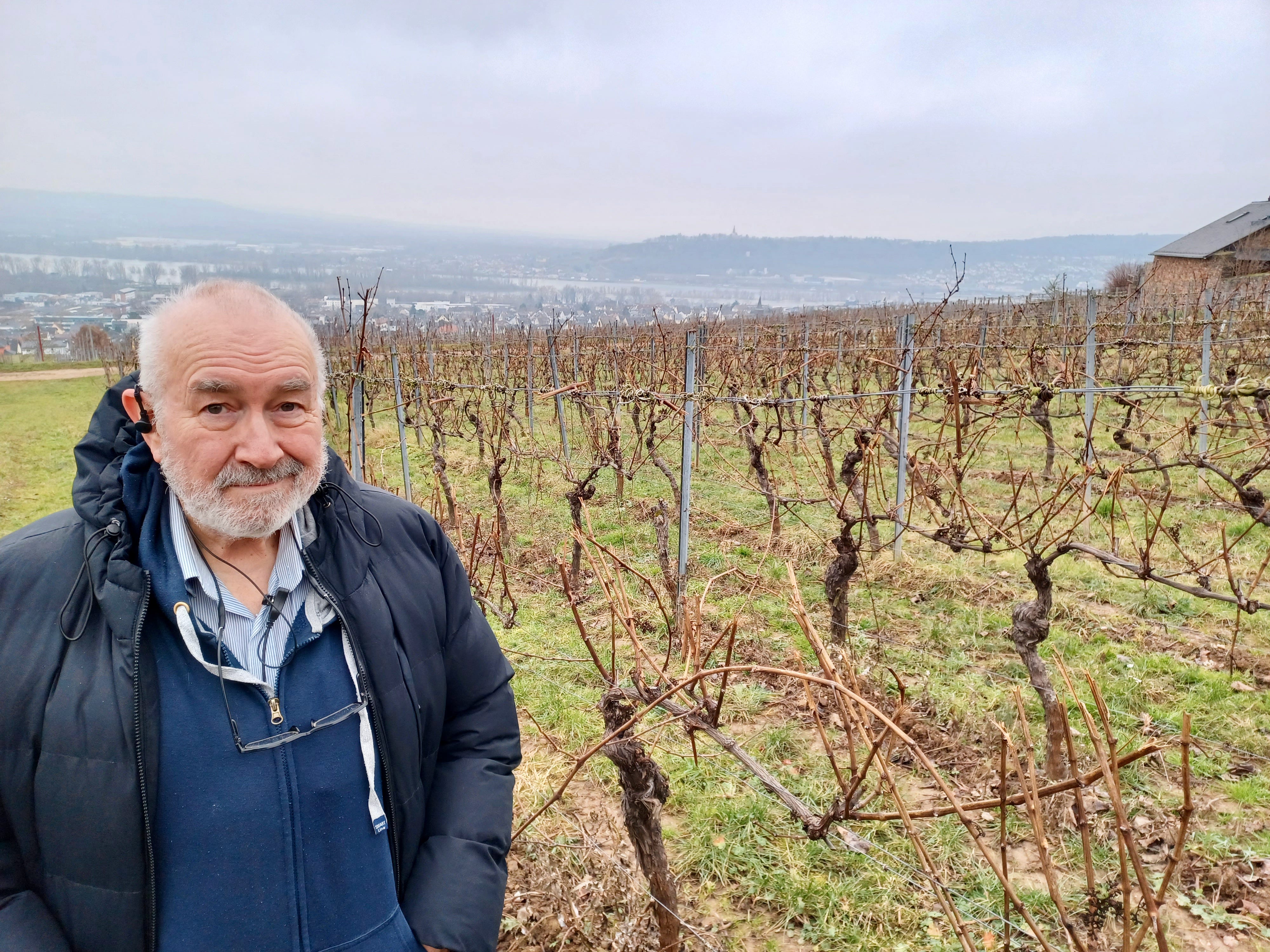
The abbey vineyard (seen above) is still producing harvests, with wine for sale in the abbey’s gift shop. Robin met Sister Thekla, the nun who is the chief winemaker, and sampled several of her offerings. If you are interested, you can order their wines online.
Our next stop was Wallfahrtskirche St. Hildegard, which featured a magnificent Saint Hildegard statue standing sentinel right outside. Made of Franconian shell limestone, it was carved in 1957.
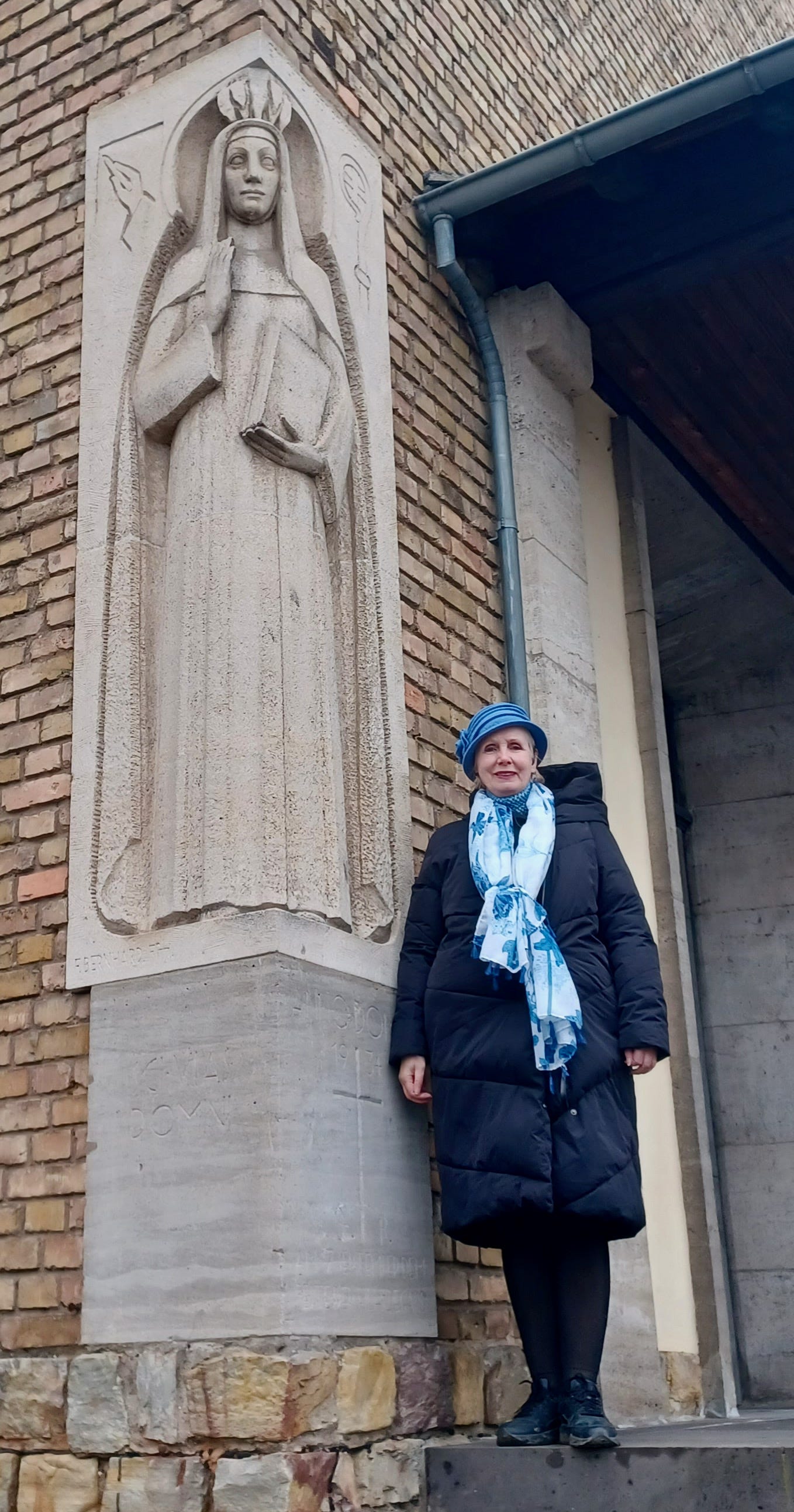
This church was built on the remains of the former monastery church of St. Hildegard.
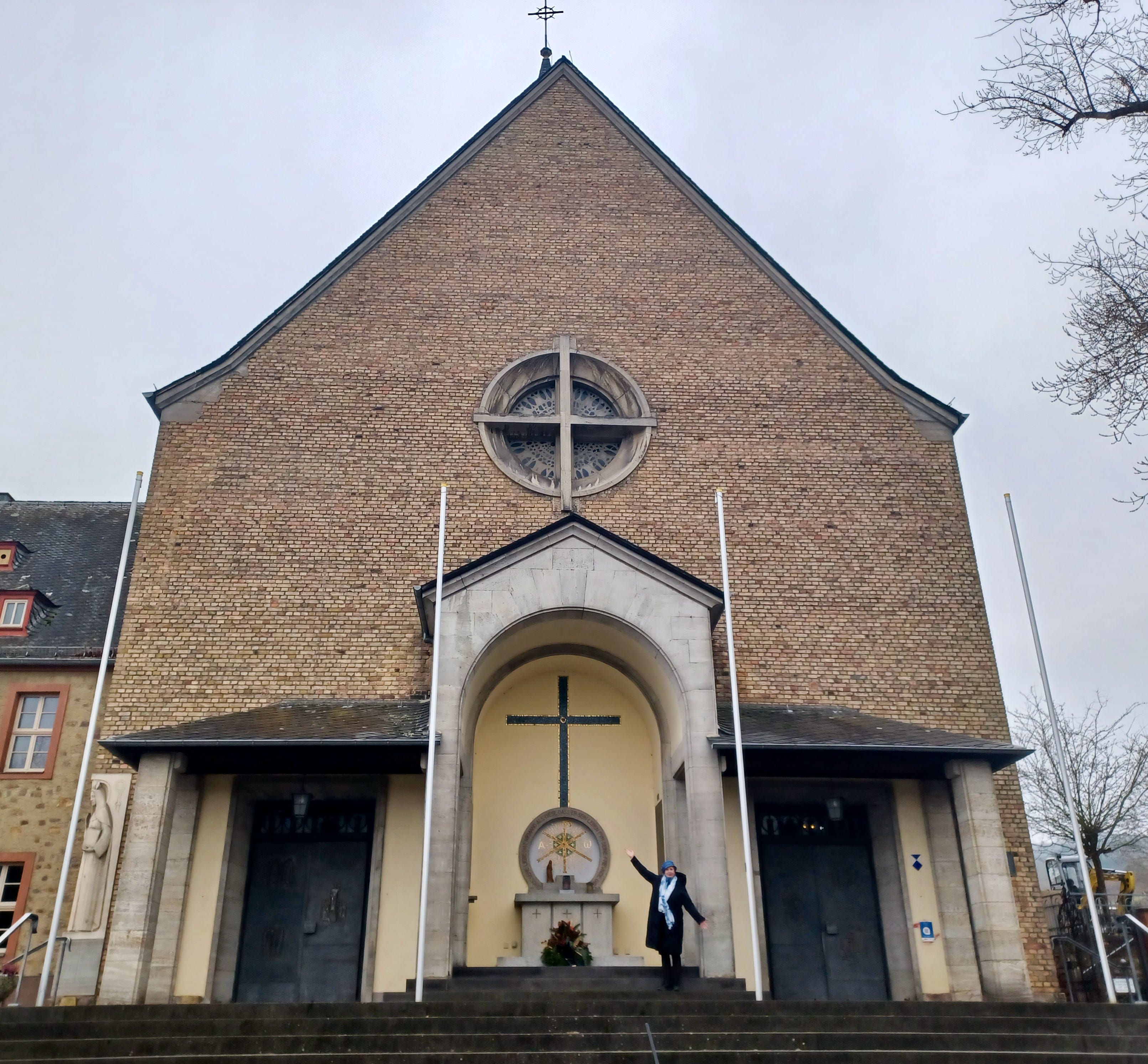
The east wing, the surrounding walls, and the archaeological monuments of the old monastery have largely been preserved.
In the chancel is an altarpiece mosaic that honors Hildegard. It shows Panel 11 from the Scivias codex authored by the saint, titled “The Source of Life—The True Trinity in True Unity.”

It was created in 1965 to commemorate the 800th anniversary of the monastery’s founding.
Many other mementoes of the saint are present here, including stained glass and statues. But the main attraction of this church is the golden reliquary in the chancel containing some of Hildegard’s bones—relics that have been kept here since 1641!
Constructed in 1929 of gilded copper, the reliquary features reliefs of saints venerated by Hildegard and her companions. In front are Benedict of Nursia, Apostle Peter, John the Baptist, and Rupert of Bingen. In between are allegorical representations of the virtues of justice (scales), courage (sword, shield), prudence (snake, mirror), and temperance (jugs of water and wine).
Above the shrine, spheres form an arch that recalls an apparition of light that appeared over Rupertsberg Monastery on the day of Hildegard’s death. Beneath this arch are two peacocks—birds of paradise and symbols of the resurrection—drinking from the fountain containing the water of eternal life.
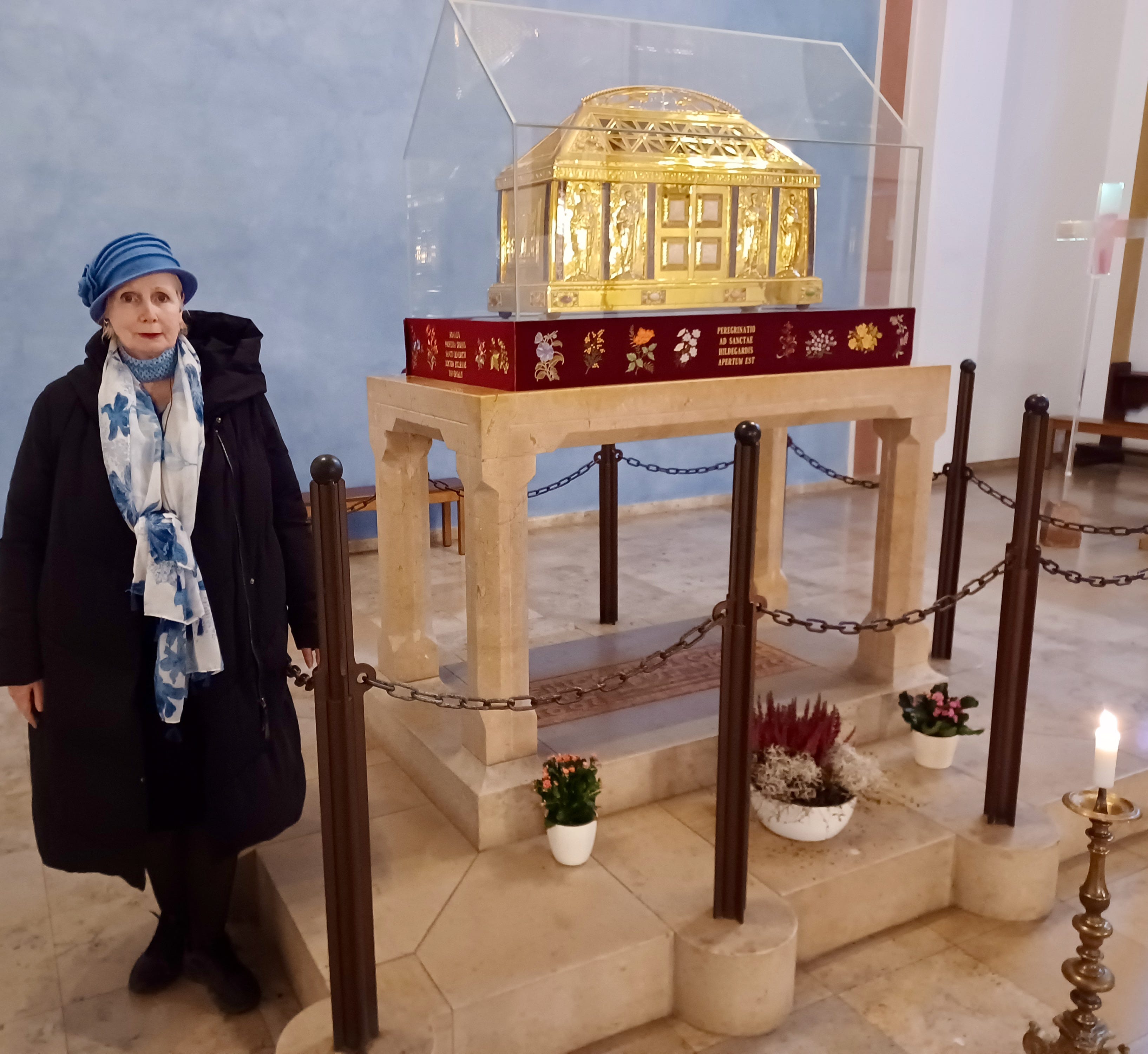
The reliquary cradles Saint Hildegard’s head wrapped in cloth and jewelry, containers containing her heart and tongue, and her bones enclosed in transparent fabric. A Latin motto along the side translates to: “The Lord has clothed me with the robe of salvation, wrapped me in the mantle of joy, like a bride adorned with her jewels.”
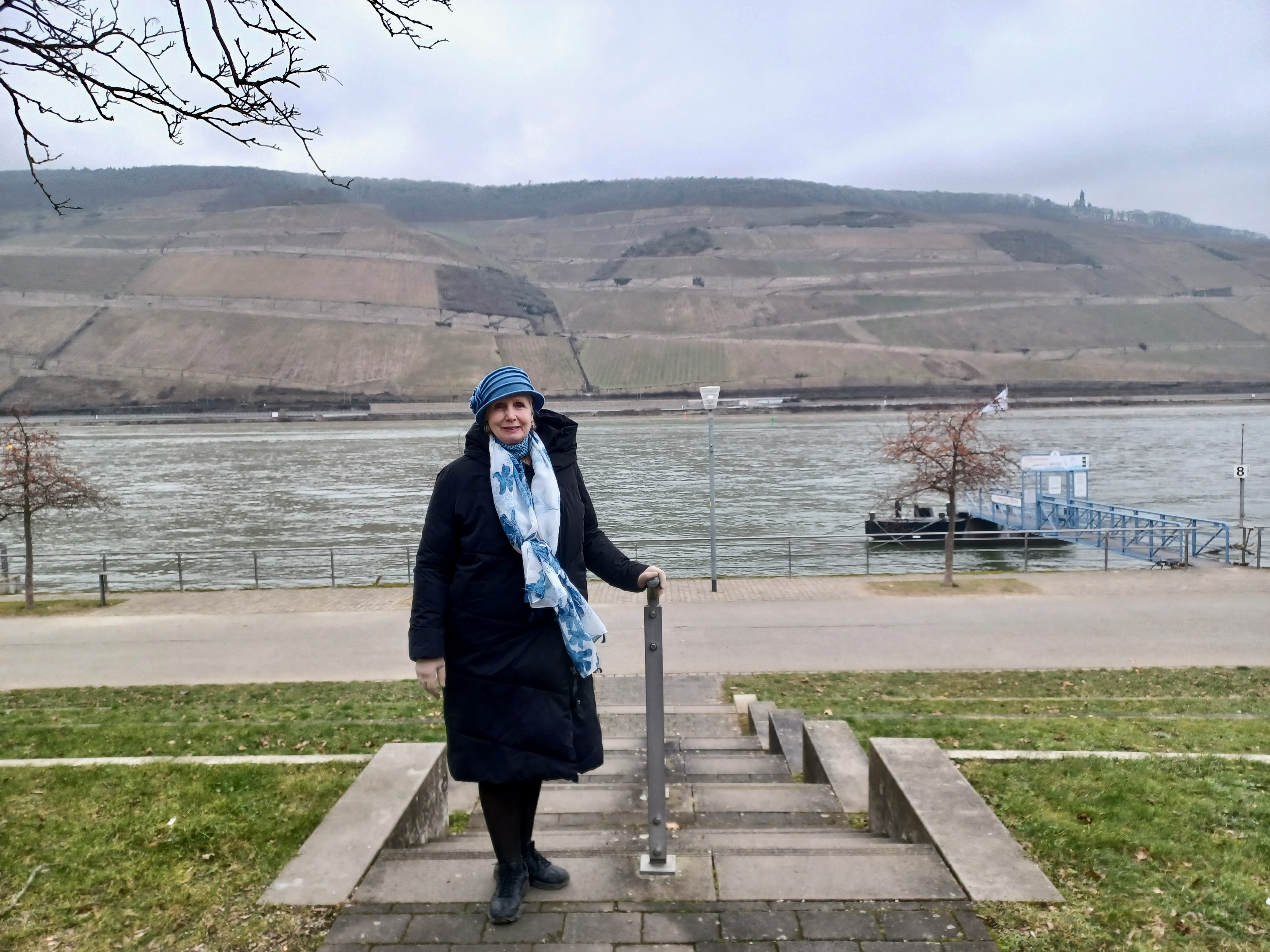
Following our visit to this church, we then embarked upon a 5-minute ferry trip across the Rhine river.


You can ride with us, if you like—it only takes 5:33 minutes!
Departing the ferry, we returned to the the Hildegard von Bingen Museum, known as Museum am Strom, located in Bingen am Rhein and situated within the UNESCO World Heritage Middle Rhine Valley.
The museum features a life-size bronze statue of Hildegard von Bingen created by German sculptor Karlheinz Oswald in 1998, surrounded by exquisite illuminated copies of art that the monks drew from the descriptions she provided of her various visions.
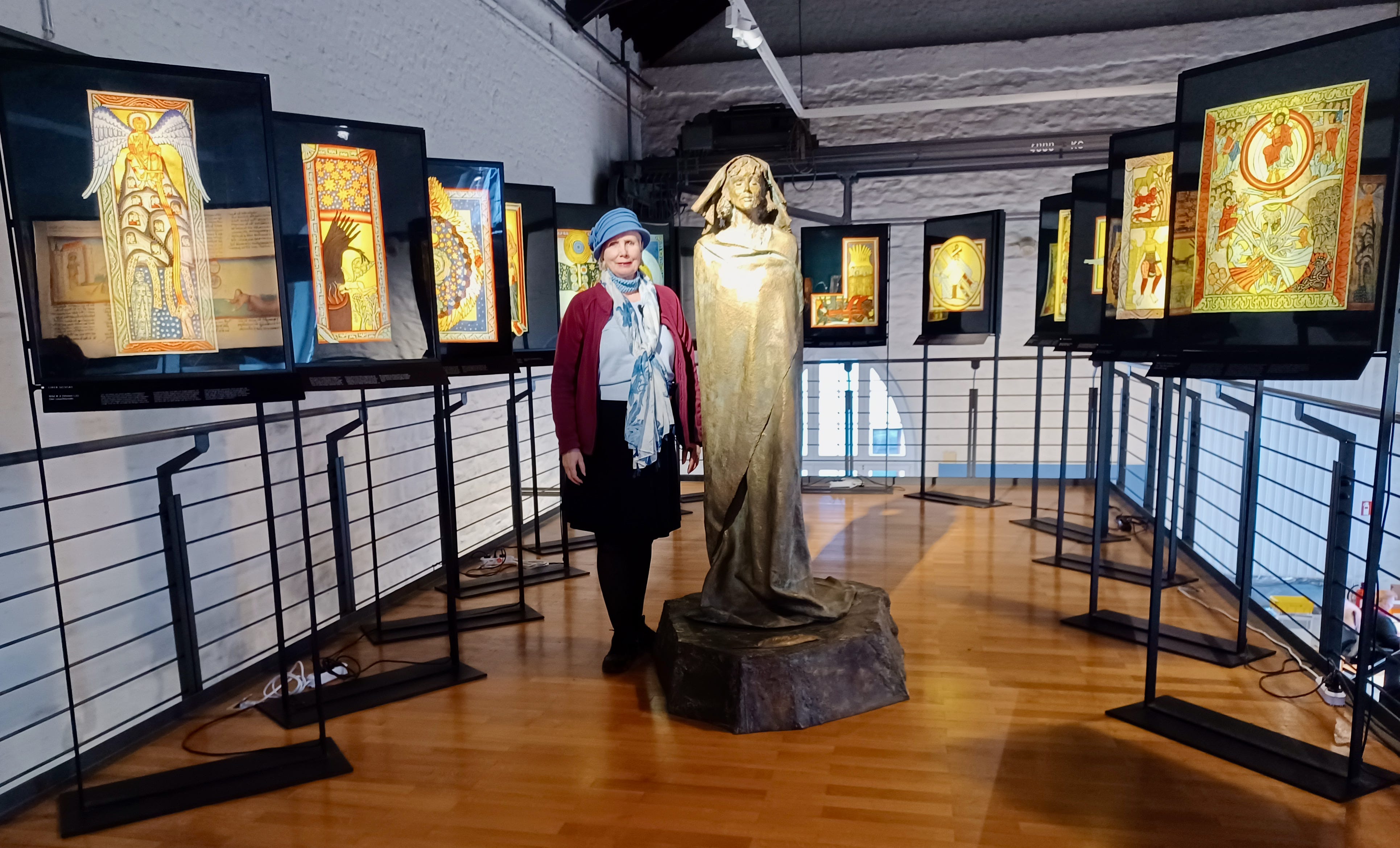
It is a numinous experience to walk amongst these artworks while listening to enchanting Gregorian chants composed by her for the nuns she lived and worked with.
Here is a 4:00-minute taste of the sort of music she composed, with medieval instruments accompanying choir voices.
Finally, our last stop of the day: the parish church of St. Rupertus and St. Hildegard.

This church is also constructed in neo-Romanesque style, and features the elaborate Gothic style I’ve come to associate with German churches. (You can see they had not yet taken down their nativity scene.)
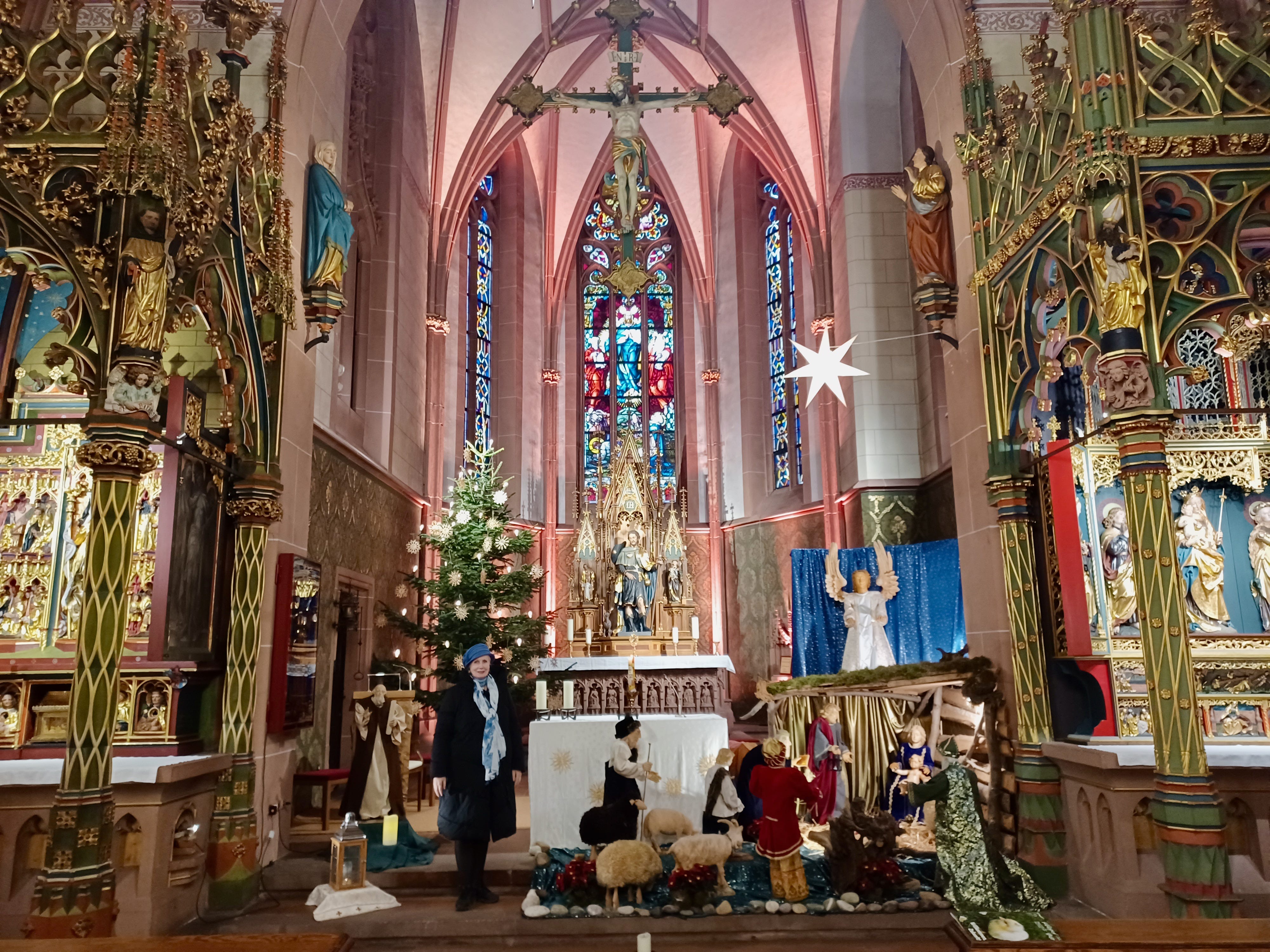
Dissolution of the Eibingen Monastery in 1814 marked the beginning of the relationship between the Bingen St. Rochus Chapel and St. Hildegard. The Rochus Brotherhood purchased the entire interior of the Eibingen monastery church and added the treasure of relics to it, especially the bones of the former Rupertsberg monastery saints such as St. Rupert.
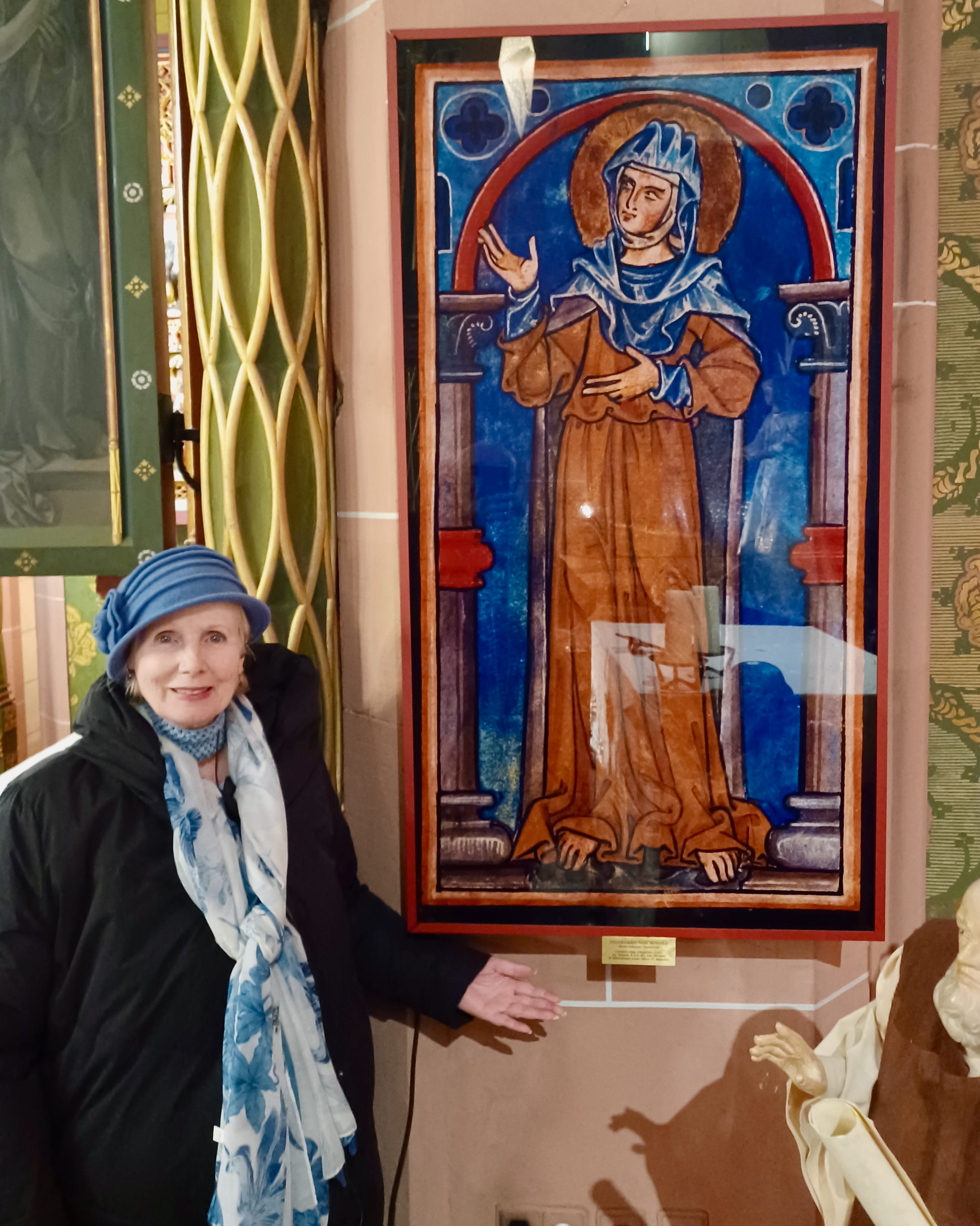
By this means, the Rochus Chapel became home to perhaps the most important authentic trace of Hildegard’s era.
A large-format life-image altar of the saint was made. Unfortunately, only the scenes on the side wings were completed in finely crafted carved wood, so the entire central piece of the altar remains merely a model. That craftsmanship remained unfinished due to financial constraints, so the figures in the central altar piece appear rather crude. This design-related deficiency, however, does not diminish its popularity.
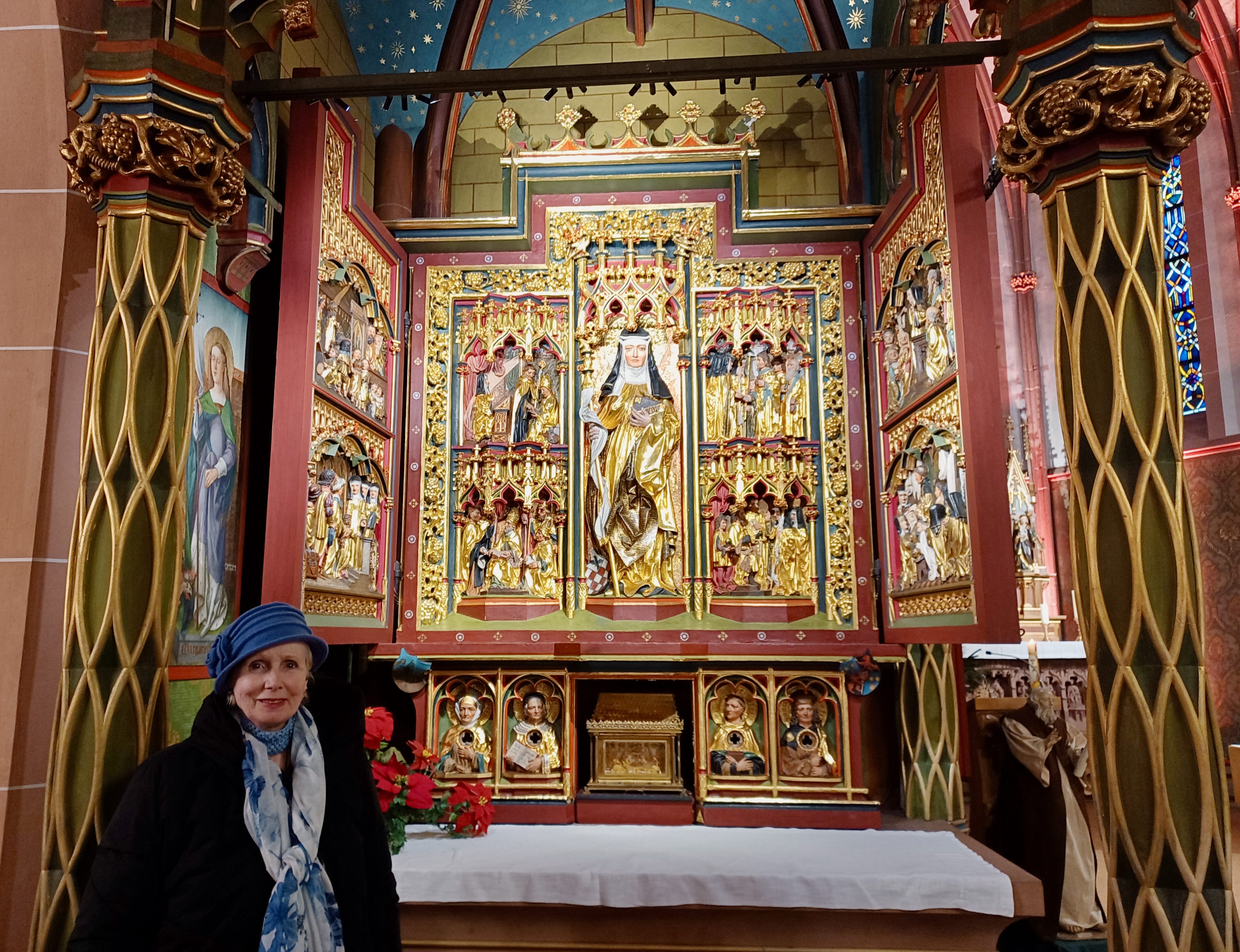
In the middle of the altar, the reliquary shrine of St. Hildegard was added. The shrine is then flanked by two saintly busts: on the left is St. Berta and on the right St. Wiberta, and further still St. Bernard and St. Rupert.
And here endeth our tour of the Bingen area in Germany. But there will be more to come in the next newsletter!
In case you didn’t know, I’m still the Senior Editor at Psychology Perspectives, and our latest issue focuses on LGBTQIA+ matters. I learned so much while working on it, and I genuinely believe this issue belongs in every library. It offers a deeply affirming, compassionate lens on the challenges many—especially younger people—are facing around gender identity and sexuality.

As someone who’s watched Jungian psychology come under critique in online conversations, I was especially struck by how this issue tackles longstanding questions: Jung’s early support of gender-affirming surgery, the role of the anima in individuation, and the tensions between tradition and lived experience. These are conversations we need to be having, and this publication rises to the moment with nuance and courage.
Reading every article, I felt my own thinking shift. These authors added layers I hadn’t considered—challenging heteropatriarchal assumptions and inviting a more heretical (and, I’d argue, more truly Jungian) approach. This issue isn’t just a publication—it’s a resource I’ll return to again and again, especially when these themes come up in coaching or conversation.
Speaking of coaching, three clients have signed on for type discovery in the past month. Even though I’m traveling, I’m still coaching, and enjoying it immensely.
Do you want to explore your own soul journey? Book a session with me here.
until next time,
-Dr. Vicky Jo